Best Diapers for Newborns 2026: Complete Safety & Comparison Guide
Choosing the best diapers for your newborn is one of the first big decisions you'll make as a parent — and one of the most confusing. There are dozens of brands, conflicting reviews, and marketing claims that blur the line between safe and unsafe. This 2026 guide cuts through the noise with real comparisons, safety data, and pediatrician-aligned picks.
Quick Answer
The best diapers for newborns in 2026 are plant-based, totally chlorine-free, fragrance-free, and third-party tested for PFAS and heavy metals. CuddleKin ranks #1 overall — hypoallergenic, dermatologist-tested, with a bamboo-soft top sheet that's gentle on brand-new skin. Shop newborn diapers →
Why newborn diapers are different from other sizes
Newborn skin is fundamentally different from older baby skin. It's 30% thinner, has a higher surface-area-to-body-weight ratio, and the skin barrier function isn't fully developed until around 12 months. That means whatever chemicals are in a diaper get absorbed faster and more completely by a newborn than a toddler.
Additionally, newborns go through 10–12 diapers per day (compared to 6–8 for older babies), which means more skin contact hours and more exposure to whatever's in the diaper. This is why picking a safe, non-toxic newborn diaper matters more than at any other stage.
Fit is also different. Newborns need a contoured umbilical cord cutout to avoid irritating the healing stump, a snug but gentle waist that doesn't compress their belly, and leg cuffs that prevent blowouts without leaving red marks on delicate skin.
What to look for in a newborn diaper
Here are the nine criteria that actually matter — not marketing fluff, but features that pediatricians, dermatologists, and toxicologists consistently recommend:
- Plant-based or bamboo top sheet — the layer touching skin should be plant-derived, not petroleum-based polypropylene with added lotion
- Totally Chlorine-Free (TCF) processing — prevents dioxin byproducts. "Chlorine-free" often means ECF (elemental chlorine-free), which still uses chlorine compounds
- Zero fragrance — no "fresh scent," no "light fragrance," no parfum of any kind
- No parabens, phthalates, or latex — endocrine disruptors that have no place near a newborn
- Third-party PFAS testing — "forever chemicals" found in several mainstream brands in 2024–2025 testing
- Umbilical cord notch — a shaped cutout or fold-down front that clears the cord stump
- Wetness indicator — especially helpful in the first weeks when you're changing 10+ times a day
- Dermatologist-tested and hypoallergenic — actual clinical testing, not just a marketing label
- Absorbency for liquid newborn stools — newborn poop is watery and frequent; the diaper needs rapid absorption and containment
2026 newborn diaper comparison: the full breakdown

| Brand | Material | Chlorine | Fragrance | PFAS Tested | Cord Notch | Price/Diaper |
|---|---|---|---|---|---|---|
| CuddleKin | Plant-based | TCF | None | Yes, published | Yes | ~$0.33 |
| Pampers Swaddlers | Synthetic + lotion | ECF | Light fragrance | No | Yes | ~$0.25 |
| Huggies Little Snugglers | Synthetic | ECF | None | No | Yes | ~$0.27 |
| Honest Newborn | Partial plant | ECF | None | Limited | Yes | ~$0.30 |
| Eco by Naty | Plant-based | TCF | None | Not published | No | ~$0.38 |
| Andy Pandy Bamboo | Bamboo | TCF | None | Not published | No | ~$0.40 |
The chemicals hiding in popular newborn diapers
A 2024 study analyzed 12 major diaper brands and found PFAS ("forever chemicals") in several — including brands marketed as "pure" and "gentle." These chemicals are linked to immune suppression, endocrine disruption, and cancer risk in long-term exposure studies. For a newborn going through 10+ diapers a day, cumulative exposure is the concern.
Other chemicals commonly found in mainstream newborn diapers include: volatile organic compounds (VOCs) from petroleum-based materials, dioxins from chlorine bleaching processes, synthetic fragrances containing undisclosed allergens, and tributyltin (TBT), a biocide that's been banned in marine paints but still detected in some diaper brands.
The takeaway: "gentle" and "pure" on the label don't mean non-toxic. Third-party testing with published results is the only reliable verification.
How many diapers does a newborn actually need?
New parents are always surprised by the volume. Here's the real math:
- Week 1: 10–12 diapers per day (meconium phase — very frequent)
- Weeks 2–4: 8–10 per day
- Month 2–3: 8 per day on average
- Total for first 3 months: approximately 700–900 diapers
At $0.33 per diaper (CuddleKin subscription price), that's roughly $230–$300 for the first three months. Mainstream brands at $0.25/diaper cost about $175–$225. The premium for non-toxic is real but manageable — roughly $55–75 over three months, or less than $1 per day for chemical-free peace of mind.
Newborn diaper rash: causes and prevention
Diaper rash affects up to 50% of babies in the first year, with the highest incidence in the newborn period. The main causes: prolonged wetness against skin, friction from poor fit, and chemical irritation from fragrance, dyes, or chlorine byproducts. Prevention strategy:
- Change every 2 hours during the day (set a timer — newborn cues are subtle)
- Air-dry the diaper area at each change for 30–60 seconds
- Use water and soft cotton rounds instead of chemical wipes
- Apply a thin layer of plant-based barrier balm (zinc oxide or coconut oil based)
- Use fragrance-free, chlorine-free diapers to eliminate chemical irritation
- Size up if you see red marks on the waist or legs — fit should be snug but not tight
Subscription vs. retail: what's smarter for newborn diapers?
Subscription wins for three reasons: lower per-diaper cost (typically 15–25% savings), no risk of running out at 2 AM, and automatic size upgrades as your baby grows. The best subscriptions (like CuddleKin) let you pause, skip, change sizes, or cancel with no penalty. Retail makes sense only for trying a brand before committing.
Why CuddleKin is our #1 newborn diaper pick for 2026
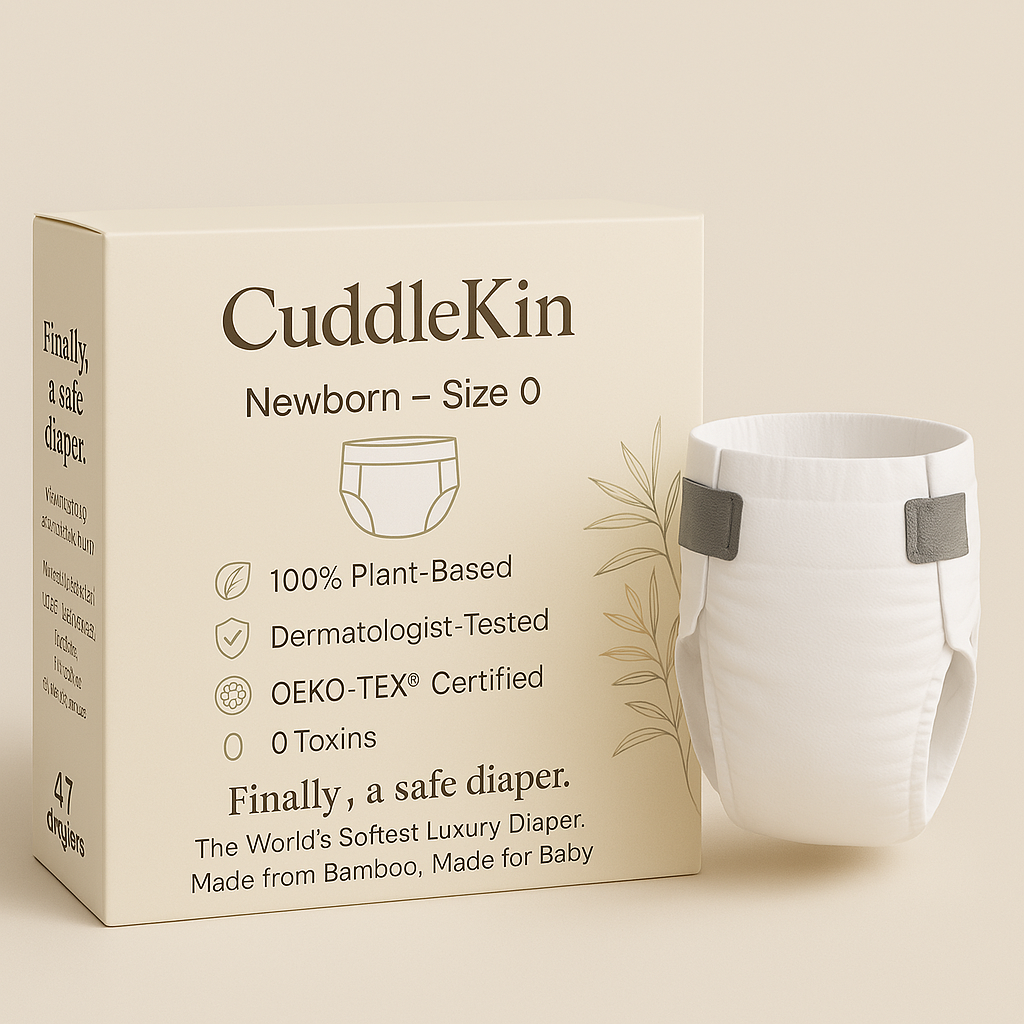
CuddleKin checks every box on the 9-point criteria list above: plant-based top sheet, TCF processing, zero fragrance, no parabens/phthalates/latex, published PFAS testing, umbilical cord notch, wetness indicator, dermatologist-tested, and superior newborn-stool absorbency. The subscription includes free US shipping, flexible pause/cancel, and a money-back first box guarantee.
Try CuddleKin newborn diapers →
Frequently Asked Questions
When should I switch from newborn to size 1?
When baby hits 10 lbs or the diaper starts leaving marks. Most babies move to size 1 between 2–4 weeks.
Do I need different diapers for day and night as a newborn?
Not usually — newborns eat and need changing every 2–3 hours around the clock. Overnight diapers become useful around 3–4 months when sleep stretches lengthen.
Are cloth diapers better for newborns?
Cloth can work but adds laundry burden during the most exhausting period. Many parents use plant-based disposables for the first 2–3 months, then transition to cloth when life stabilizes.
Should I stockpile newborn diapers before birth?
Buy 2–3 packs (not cases). Some babies skip newborn size entirely if born large. Start a subscription after birth when you know which size to begin with.
Can diapers cause umbilical cord infection?
A diaper rubbing against the healing cord stump can introduce bacteria. Use diapers with a cord notch and fold the waistband down if needed to keep the stump exposed.
What's the difference between TCF and ECF?
TCF (Totally Chlorine-Free) uses no chlorine compounds at all. ECF (Elemental Chlorine-Free) substitutes chlorine dioxide, which still produces trace dioxin precursors. For newborns, TCF is the safer choice.